Intuitive Shift in IR
My work in infrared photography is approached intuitively rather than analytically, guided initially by my feelings, with the technical aspect following.
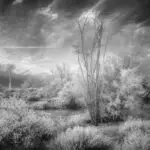
Certain landscapes naturally call for it. Open land, solitary forms, and especially shifting skies. Infrared transforms the familiar into something quieter and more timeless, allowing unseen qualities of a place to surface and shape the mood of the image.
In infrared work, the focus shifts away from documenting how a place looks and toward interpreting how it feels. The sky often carries the emotional weight, tone replaces color as the primary language, and simplicity allows the image to breathe. Working with restraint and trust in intuition lets the photograph unfold naturally. When an image feels honest, dreamlike, and emotionally true, it has succeeded.
Infrared photography often attracts attention for its visual drama, but what’s most often overlooked is that it demands more intention, not less. The glowing foliage and darkened skies can be seductive, yet those qualities alone don’t carry an image. Without careful attention to composition, infrared can quickly become visually chaotic, rather than a meaningful photograph.
Another common oversight is how much infrared depends on restraint. It’s easy to push contrast or effects too far in processing, stripping the image of subtlety and depth. Infrared responds best when highlights are protected, mid tones are strong, and the final image feels believable within the framework of traditional monochrome images. The strongest infrared photographs tend to feel timeless rather than sensational.
Perhaps the most overlooked aspect of infrared is that it is interpretive by nature. It isn’t meant to describe the landscape accurately, but to translate an internal response to place. When approached this way, infrared becomes less about novelty and more about storytelling, revealing mood and presence rather than surface detail.
The most common things photographers forget (or underestimate) when shooting infrared:
- Focus Shift
Infrared light focuses at a slightly different plane than visible light. Photographers often forget that lenses can behave differently in IR—resulting in soft images if autofocus or calibration isn’t dialed in. Mirrorless cameras have mitigated this issue.
- Lens Hot Spots
Many lenses that are excellent for visible light produce bright circular “hot spots” in infrared. This is easy to forget when switching systems or focal lengths—and it can ruin an otherwise strong composition.
- Exposure Is Not Intuitive
IR exposure is a bit more sensitive. Bright sun can blow out highlights very easily. Skies and water can react unpredictably, sometimes appearing very dark. Still, I always adjust for highlights stop down one stop.
- White Balance Matters (A Lot)
Failing to set a proper custom white balance—either in-camera or in RAW—can severely limit tonal control later. Many forget that good IR files start before post-processing
- Midday Light Can Be a Gift (or a Trap)
Unlike visible light photography, infrared often thrives in strong sun—but harsh overhead light can still flatten form and texture if composition isn’t intentional. Timing still matters, just differently.
- Composition Still Comes First
It’s easy to rely on the “wow” factor of glowing foliage and dark skies. What’s often forgotten is that infrared doesn’t fix weak composition—strong structure, balance, and intent matter even more when the scene becomes surreal.
- Post-Processing Is Part of the Capture
Infrared is not a “straight-out-of-camera” medium. Many photographers underestimate how critical thoughtful processing is to shaping mood, preserving highlights, and achieving a believable tonal range.
- Infrared Is Interpretive, Not Literal
Perhaps the biggest thing forgotten: Infrared isn’t about realism. It’s about translation. Trying to force it to look “normal” often strips it of its power.
- Glow and Grain
In HIE film, there is a glow and grain that does not occur naturally in converted digital cameras, so it must be added, if desired.
Comments are closed.