Sacred Land
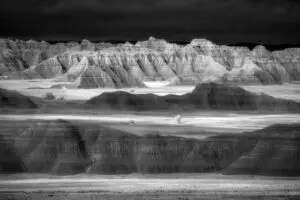
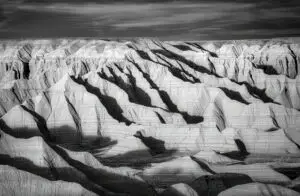
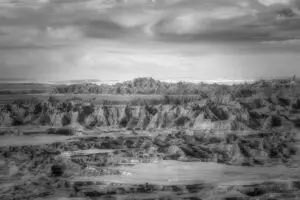
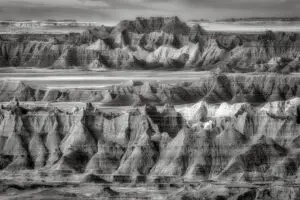
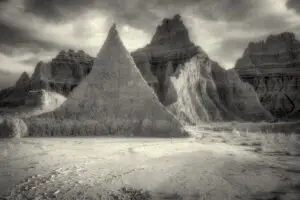
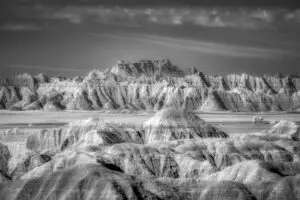
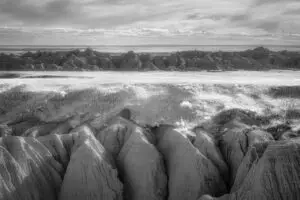
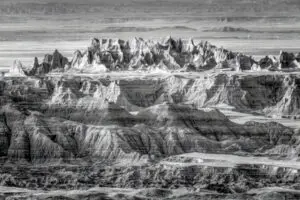
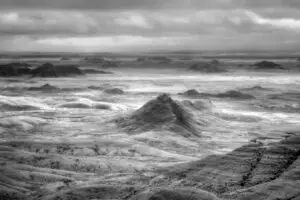
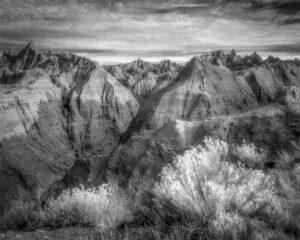
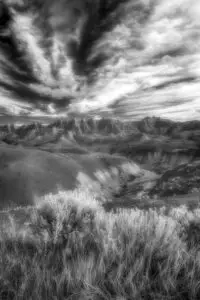
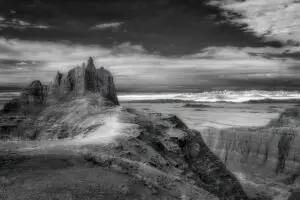
The land is layered. Gray, rust, cream, yellow, layer on layer, each band a season of a world that no longer exists. A shallow sea once lay here, and wind and rain have been revealing its floor ever since.
The Lakota named it Mako Sica, land bad. The name is true, meaning little water, clay that turns to glue in the rain (especially on hiking boots), cliffs that give way underfoot, summers that bake and winters that are cold. French trappers later arrived at nearly the same words. But people have lived in and around this country for some twelve thousand years, and the Lakota have called it home for centuries. Stronghold Table, in particular, was never a place to live. It was a ceremonial place.
Long before paleontologists arrived, the Lakota knew the region’s ancient creatures as Unk-tegila, the water monsters, and gave them a place in the Oglala creation story. Every Indigenous culture around the world have creations stories, most are unique to land of their origin.
In 1868 the United States signed the Fort Laramie treaty that created the Great Sioux Reservation, which took in this country. In 1889 Congress broke that reservation into smaller ones. Pine Ridge, where the southern half of the Badlands lies, was one of them.
By the winter of 1890, the Sioux were living on reservations with much of their land gone, and many had turned to the Ghost Dance, a ceremony of hope for the return of the dead and the herds of bison. Government agents grew alarmed by it. On Stronghold Table, the last Ghost Dance of that century is believed to have been held. Weeks later, at Wounded Knee Creek, soldiers killed roughly two hundred Lakota men, women and children, or more by some counts. The dance was banned. Decades later, it came back.
In 1942 the War Department took 341,726 acres of Pine Ridge for a gunnery range. It was used for bombing and gunnery practice through at least 1945, by some accounts 1948, and the National Guard fired artillery there afterward. Families were forced out, and tribal and government accounts disagree on how many. Most of the land was returned between 1948 and 1977. The Air Force still holds about 2,500 acres because of unexploded ordnance, and live munitions are still found on Oglala land.In 1968 the range was declared excess, and Congress conveyed most of the land to the tribe on the condition that the South Unit be administered by the National Park Service. In 1976 the tribe and the Park Service signed an agreement adding 133,300 acres to the monument, and two years later it became a national park. Many on Pine Ridge say the Park Service never kept its promises, including jobs for tribal members and the return of bison.
In spring 2002, about thirty members of the Oglala Sioux Tribe camped on the Stronghold after the Park Service allowed off-road vehicles onto Stronghold Table, where they reportedly rolled over gravesites. Some accounts say the occupation lasted about three years. Out of that conflict grew a proposal for the nation’s first tribal national park. In 2012 the Interior Department recommended it, with the Oglala Sioux in charge. It needed an act of Congress, talks later stalled, and I found no sign that Congress ever acted.
This land holds so much history and trauma. A sea, a treaty, a dance, a massacre, a bombing range, and a long argument over who it belongs to. It still stands in bands of color, and the Oglala Lakota are still here. This is my tribute to the Land and those who know. She spoke to me deeply, revealing how she wishes to be seen, as a frequency of light.

Comments are closed.