Tapping Into the Flow
Tapping Into the Flow
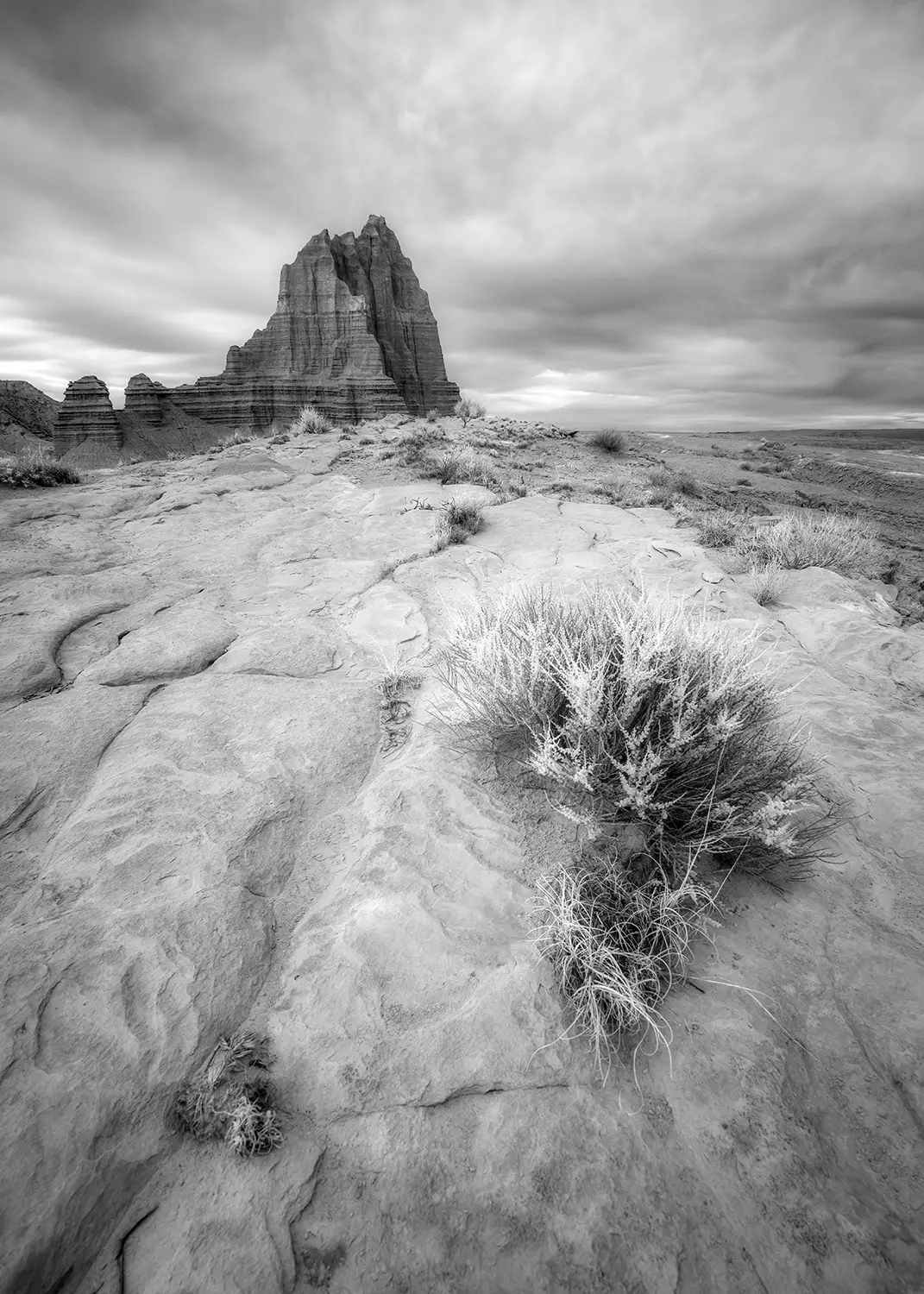
Several years ago, I found myself in a very remote landscape, nothing but rocky badlands, monoliths, and sky, just a beautiful expanse of Mother Earth. I had hiked in alone, decided to sit down on a large rocky outcrop, and let the silence gather around me. I have never had a moment like this before or since.
For the first time in my life, I heard nothing.
No birds.
No water.
No road noise.
No planes overhead.
Only the steady beat of my heart and, astonishingly, the subtle sound of my own blood moving through my body.
I sat there for nearly an hour, wrapped in that profound stillness. I remember thinking an animal might wander by, as if the moment needed anything more, but nothing disturbed it. The silence held. And in those moments, I felt myself drop into a deeper state of awe—that nature could be so very still. I was simply there, completely present in that moment.
Recently, a friend asked if I plan my photographs before I go out. I told her the only thing I ever look at is the weather. I have a fondness for the contrast and definition of infrared skies, but beyond that, I don’t organize anything at all. I’m quite organized in other areas of my life, but when it comes to my photography, planning dissolves. Everything I do is intuitive. My very best work happens when I’m alone, moving with that intuition, letting it lead me.
I explained this to her and finally said, “I just tap into the flow.”
She looked at me blankly, as if the word flow carried no meaning for her.
But flow has been spoken about by many people across psychology, art, and spirituality.
Mihaly Csikszentmihalyi, who pioneered the study of flow, described it as complete absorption—a state where the ego softens, creativity becomes spontaneous, and the act itself becomes its own reward.
It is the perfect balance of challenge and skill, where you are doing without thinking about doing.
“Flow is the state in which people are so involved in an activity that nothing else seems to matter; the experience itself is so enjoyable that people will do it even at great cost, for the sheer sake of doing it.”
Julia Cameron, in The Artist’s Way, writes about flow as a kind of spiritual alignment—a clearing of the inner channels so creativity can move through us. She reminds us that art is not about forcing; it is about listening. Following synchronicity. Softening the inner critic. Showing up for the conversation.
“In order to thrive as artists we need to be available to the universal flow. When we put a stopper on our capacity for joy by anorectically declining the small gifts of life, we turn aside the larger gifts as well.”
Steven Pressfield calls the opposite of flow “Resistance,” the force that keeps us from creating. Flow, to him, arrives when we commit, when we show up daily, when we become available to the Muse. In this view, inspiration is not an accident. It is something we meet halfway.
“This is magic. This is flow.
If we could achieve this by taking a pill or reading a self-help manual, we’d all do it. (Some of us have tried.) But the reality is that it takes work.
Magic takes work.
Flow takes work.
Art takes work.”
Carl Jung spoke of entering an imaginal realm where archetypes rise from the unconscious. Though he never used the word flow, he described what it feels like when images form before thought, when the psyche guides the hand, when art becomes a channel to something older and deeper than the conscious mind.
“Art is a kind of innate drive that seizes a human being and makes him its instrument. The artist is not a person endowed with free will… but one who allows art to realize its purpose through him.”
“From the living fountain of instinct flows everything that is creative; hence the unconscious is not merely conditioned by history, but is the very source of the creative impulse.”
Joseph Campbell spoke of flow through the lens of myth—through the story each soul is born to live. For him, the creative state emerges when the artist steps into alignment with their inner myth, the deep pattern that has been quietly shaping their life from the beginning.
“In one of the Upanishads it says, when the glow of a sunset holds you and you say ‘Aha,’ that is the recognition of the divinity. And when you say ‘Aha’ to an art object, that is a recognition of divinity. And what divinity is it? It is your divinity, which is the only divinity there is. We are all phenomenal manifestations of a divine will to live, and that will and the consciousness of life is one in all of us, and that is what artwork expresses.”
Rick Rubin calls flow attunement—the art of becoming receptive, of clearing noise and clutter, of opening the senses so that the work itself can tell you what it wants to be.
“The act of creation is an attempt to enter a mysterious realm. A longing to transcend. What we create allows us to share glimpses of an inner landscape, one that is beyond our understanding. Art is our portal to the unseen world.”
All of these perspectives point to the same truth:
Flow is what happens when your inner world and outer expression unify.
It is the moment the mind stops resisting, and the deeper self begins to speak.
For an artist like me, whose work is rooted in the memory of the land and my own personal vision, flow feels like a breath—an opening, a quiet knowing that guides the image long before I press the shutter. My infrared work especially lives in this space. I am literally photographing what the human eye cannot see through infrared photography, which mirrors my inner experience of creating from an unseen depth.
My art is about capturing stillness. I photograph nature not to show what it looks like, but to share the stillness I feel when I’m there. This creates a very otherworldly image, the way I see the land. I use my camera to mirror the quiet of the Earth and to help others feel that stillness too.
In that way, my work is not only what I see, it is what I sense. It is how I bring my vision into the world, through a deep sense of connection.
And every time I enter that state, whether on a rocky outcrop, along rivers lined with cottonwoods, or surrounded by prairie grass on the Great Plains—I return to the flow, that silent thread of intuition and presence that has guided me my entire creative life.

Comments are closed.